HOW WE CREATED THEM
The three Tiny Forests have each been sited where there is little chance of developing or extending our wild flower meadows. All three sites had been overtaken by brambles, (we have plenty of brambles), are damp, and partially shaded. In each case the site was cleared and dug over by hand, removing large quantities of ancient roots, then and mulched with waste cardboard topped with wood chippings and leaves.
Our experience with the first Tiny Forest was that the greatest challenge to newly planted saplings is the lack of water. We upgraded our first, rather small, rainwater collector with an IBC (Intermediate Bulk Container). These are used for the shipping of liquids and can best be described as a cage on a pallet containing a massive plastic box – like a very (very) large wine box. A lean-to roof is constructed to collect rainwater that is then directed by guttering and a downpipe to fill the IBC. Shifting hundreds of litres of water uphill using 10 litre watering cans is slow and exhausting. Instead we have a small, battery-operated transfer pump which we can move around from site to site. It can empty an IBC in 90 minutes. Water collected over the winter provides a starting volume of 1,000 litres, which is vital, as recent summers have had prolonged periods of drought. We now have five such IBCs, providing total water storage of 5,000 litres.
WHAT ARE THEY?
Tiny Forests are dense, fast-growing native woodlands, planted in areas no larger than a tennis court. The aim is to provide maximum carbon capture from a relatively small area. Due to the high density the trees grow upwards very quickly and soon shade out the area, enhancing bio-diversity beneath. We planted Tiny Forests 1 and 2 at the rate of 2.5 saplings per square metre. Tiny Forest 3 (very close to Tiny Forest 1) was planted at a density of 4 saplings per square metre. It will be interesting to discover which fares better.
Our three Tiny Forests have been created in an annual programme commencing with the site preparation for Tiny Forest 1 late in 2020. All three can be found using the maps at our three main gates into the fields (or in the Maps section of this website), and each has an interpretation notice providing further information.
TINY FOREST 1 is located in the NE corner of the North Field. The 580 saplings were planted in January 2021 and comprise 17 species (in descending number order): rowan, goat willow, wild cherry, oak, downy birch, alder, dogwood, silver birch, dog rose, crab apple, hawthorn, hornbeam, beech, grey willow, field maple, bird cherry and hazel.
TINY FOREST 2 is located in the NW corner of the West Field. The 300 saplings were planted in January 2022 and comprise 15 species (in descending number order): oak, hawthorn, rowan, silver birch, dog rose, dogwood, grey willow, goat willow, downy birch, field maple, beech and hornbeam.
TINY FOREST 3 is located in the NW corner of the East Field. The 450 saplings were planted in January 2023 and comprise 24 species (in descending number order): oak, beech, hornbeam, sliver birch, hawthorn, rowan, hazel, field maple, alder, common buckthorn, bird cherry, downy birch, small leaved lime, wych elm, yew, wild service tree, spindle, osier willow, crab apple, wild cherry, goat willow, grey willow, crack willow and holly.
Photos of Tiny Forest 1
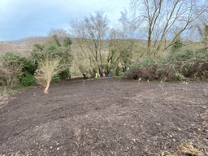
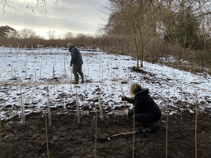
Site Preparation and Planting, January 2021
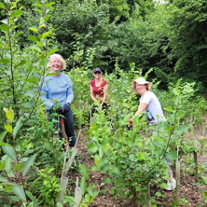
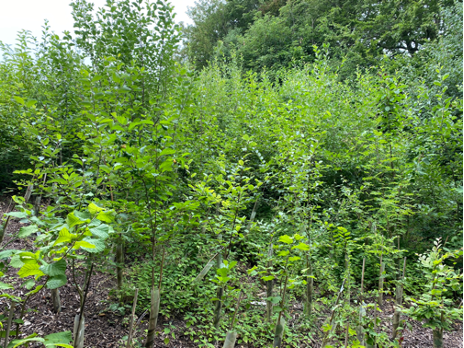
Weeding and Mulching, July 2022. Blooming(!), June 2023
 Home
Home 